Pick up almost any cleaning product and the front label makes the promise sound simple. Cuts grease. Kills germs. Fresh scent. Safe for the home.
Turn the bottle around and it changes completely.
Now you are looking at hazard symbols, vague ingredient categories, dilution instructions, and claims like “natural” or “eco” that sound useful but often tell you very little on their own. That gap between marketing and meaning is where most confusion starts.
At VIP Cleaning, we use cleaning products in real homes and working environments every day. From that experience, one thing stands out. Most people are not careless. They are under-informed. Labels often tell you just enough to use the product, but not enough to compare it properly, understand the risks clearly, or know when a milder option would do the job just as well.
This guide explains what UK cleaning labels really mean, what ingredients are commonly used, what the hazard language is actually telling you, and how to make safer, more informed choices without turning routine cleaning into a chemistry lesson.
Table of Contents
Why cleaning labels are so confusing in the UK
Cleaning labels are not as transparent as most shoppers assume.
Unlike food labels, cleaning products are rarely designed to give you a full, plain-English breakdown on the bottle. That is one of the main reasons shoppers often struggle to work out what a product contains, how strong it is, and how it differs from similar options on the shelf. In practice, the label usually gives you enough information to use the product, but not always enough to understand it properly.
In practice, that means you often see:
- hazard symbols without much interpretation
- ingredient classes instead of full ingredient lists
- broad terms like “fragrance” instead of specific scent chemicals
- eco claims that sound reassuring but are hard to verify
That is why two products can look similar on the shelf while being very different in strength, exposure risk, and suitability for your home.
What cleaning labels are legally required to show
This is where things become more useful. The label may not tell you everything, but it usually tells you more than people realise if you know what to look for.
Hazard pictograms
The most important symbols on a cleaning product are the hazard pictograms used under the CLP system, which stands for Classification, Labelling and Packaging.
These symbols tell you about the type of risk, not whether the product is “good” or “bad”.
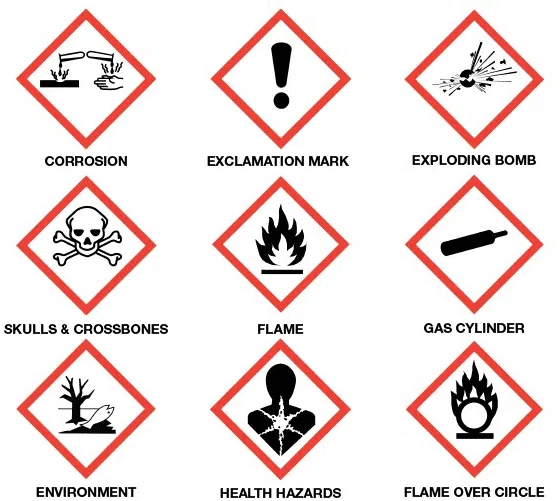
Common examples include:
- Exclamation mark – may cause skin irritation, eye irritation, or respiratory irritation
- Corrosion symbol – can cause burns, serious eye damage, or damage to certain materials
- Health hazard silhouette – used for more serious long-term hazards in some products
- Environment symbol – harmful to aquatic life and should not be poured away carelessly
This matters because the front label might say “powerful bathroom cleaner”, while the back label is telling you it needs gloves, ventilation, and careful storage.
Signal words
Cleaning labels may use words such as:
- Danger – higher hazard category
- Warning – lower hazard category, but still requires care
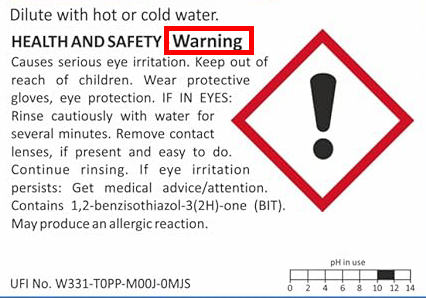
These are not marketing phrases. They are part of the classification system.
H-statements and P-statements
Some products also include formal hazard and precaution phrases, often called:
- H-statements – what the hazard is (red)
- P-statements – what precautions you should take (yellow)
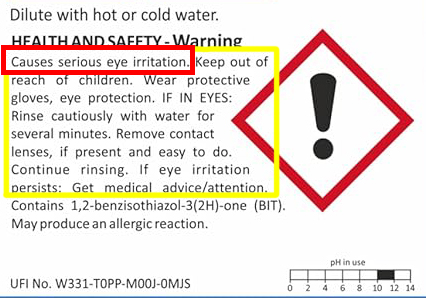
For example, a label may effectively be saying:
- causes serious eye irritation
- keep out of reach of children
- wear protective gloves
- use only in a well-ventilated area
Most people scan past this section. In practice, it is often the most honest part of the whole label.
Directions for use
This is the section people ignore most often and then blame the product for being too weak or too harsh.
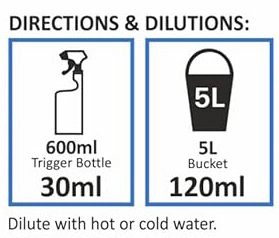
Directions tell you:
- how much to use
- whether the product should be diluted
- how long it should remain on a surface
- whether it should be rinsed away
A stronger dose does not automatically mean a better result. Often it just means more residue, stronger fumes, and more irritation.
Why full ingredient disclosure still feels incomplete
This is one of the biggest reasons people find cleaning labels frustrating. Many shoppers assume the bottle will tell them exactly what is inside, when in reality on-pack information is often limited. That is why it helps to treat the label as a starting point rather than the full picture.
In simple terms, you may see:
- ingredient categories
- selected preservatives
- fragrance allergens in some cases
- website references for more detail
What you often do not get on the bottle is a fully shopper-friendly ingredient breakdown in everyday language.
That is why it helps to think of the label in two parts:
The front sells the result. The back reveals the risk and usage conditions.
If you want fuller transparency, you often need to check the manufacturer’s website, product data sheet, or safety information.
What common cleaning ingredients actually do
Long ingredient names look alarming because they are unfamiliar, not necessarily because they are unusually dangerous. The useful question is not “Is this chemical bad?” but “What is it doing in this product, and how much exposure does it create?”
Here are the main ingredient groups you are likely to come across.
Surfactants – the ingredients that lift dirt and grease
Examples include sodium lauryl sulphate and sodium laureth sulphate.
Their job is to break surface tension so grease, grime, and residues can be lifted and rinsed away. Without surfactants, many cleaners simply would not clean effectively.
What matters in practice:
- they are useful and common
- they can irritate sensitive skin
- frequent direct contact matters more than occasional use
This is especially relevant if you clean without gloves or use strong products repeatedly on the same day.
Disinfectants – the ingredients that kill microbes
Examples include sodium hypochlorite in bleach-based products and quaternary ammonium compounds in some antibacterial sprays and wipes.
These ingredients are designed for hygiene control rather than general tidying.
That distinction matters.
A lot of homes use disinfectant products for jobs that only require routine cleaning. For example, wiping dust from a sideboard does not require the same chemistry as cleaning a toilet, dealing with raw meat residue, or sanitising a bin area.
Used correctly, disinfectants have a place. Used constantly and unnecessarily, they increase exposure without always adding real benefit.
Solvents – the ingredients that break down stubborn grime
Some cleaning products use solvents such as alcohols or glycol ethers to dissolve oily soils, adhesives, ink, or heavy grime.
You often find these in:
- glass cleaners
- degreasers
- heavy-duty kitchen products
- some multipurpose sprays
These ingredients can be effective, but stronger solvent-based products are more likely to create noticeable fumes, especially in small bathrooms, kitchens without ventilation, or commercial spaces where cleaning happens repeatedly.
One ingredient that often gets less attention is 2-butoxyethanol, a solvent sometimes found in stronger cleaning products. It is used because it helps cut through grease and stubborn grime effectively, but it also deserves careful handling, especially in products used often or in poorly ventilated spaces.
Fragrance – the ingredient that creates the idea of “clean”
This is where labels become especially vague.
“Fragrance” or “parfum” is often used as a catch-all term rather than a transparent list of each scent component. That matters because fragrance adds smell, not cleaning power.
In practical terms:
- fragrance can make a room smell clean without making it cleaner
- strong scent can trigger headaches or irritation for sensitive users
- scent-heavy products are often overvalued because people equate smell with hygiene
That is one of the most common misunderstandings we see in cleaning. A surface can smell fresh and still need proper cleaning. A surface can also be hygienically clean without smelling strongly perfumed.
In most cases, fragrances are used to mask the smell of a cleaning product.
Preservatives – the ingredients that keep the product stable
Preservatives stop microbes from growing inside the bottle, especially in water-based products that sit in cupboards for weeks or months.
Some preservatives attract concern online, but the practical point is simpler. Their presence usually reflects shelf-life and product stability, not automatically a high-risk product.
Still, people with skin sensitivity may want to be more selective, especially with products that stay in prolonged contact with the hands.
Optical brighteners, dyes, and extras
Some products also contain:
- colourants
- optical brighteners
- added scent boosters
- shine agents
These are not always essential to the job. They may improve appearance, scent, or visual effect rather than core cleaning performance.
That is worth noting because a simpler formulation can sometimes do the same practical job with fewer extras.
A plain-English ingredient decoder
Here is the sort of quick reference most label guides leave out.
| Ingredient type | What it does | Where you often find it | What to watch for |
|---|---|---|---|
| Surfactants | lift grease and dirt | washing-up liquid, sprays, floor cleaner | skin irritation with frequent contact |
| Disinfectants | kill bacteria or viruses | bleach, antibacterial sprays, toilet cleaners | overuse, fumes, unnecessary everyday exposure |
| Solvents | dissolve oily or stubborn grime | degreasers, glass cleaner, kitchen sprays | fumes and respiratory irritation in enclosed spaces |
| Fragrance | adds scent | most mainstream household cleaners | sensitivity, strong smell without added cleaning benefit |
| Preservatives | keep product stable in storage | sprays, liquids, gels | sensitivity for some users |
| Acids or descalers | dissolve mineral build-up | limescale removers, toilet cleaners | corrosive risk, never mix carelessly |
Are cleaning products actually harmful?
The honest answer is this: they can be, but risk depends on the product, the dose, the method, and the frequency of exposure.
This is where online advice often becomes unhelpful. One side treats all conventional cleaning products as toxic. The other side acts as if there is nothing to think about at all.
Reality sits in the middle.
Short-term harm
Improper use can cause:
- skin irritation
- eye irritation
- headaches
- coughing or throat irritation
This often happens because of:
- overuse
- poor ventilation
- using multiple products in one session
- spraying close to the face
- cleaning in a confined area
Long-term exposure
A lot of advice about cleaning products focuses on single uses, but repeated exposure matters too. For people who clean often, use multiple products regularly, or work in enclosed spaces, the effect of frequent contact over time can become more important than any one cleaning session.
That matters because long-term exposure is most relevant for:
- professional cleaners
- people who deep clean frequently
- workers in commercial settings
- anyone using spray products heavily in enclosed spaces
Spray products deserve extra care because they are easier to inhale than liquids applied to a cloth. That airborne exposure can make them more irritating, especially in small, poorly ventilated spaces or when they are used repeatedly. This does not mean every spray product is unsafe, but it does mean the format itself can increase exposure.
That does not mean every spray is dangerous. It means method matters.
Who should be more cautious
Some groups deserve a more careful approach:
- children and babies – because of hand-to-mouth contact and more time spent on floors and surfaces
- pet owners – because paws, grooming, and low-level surface residues matter
- people with asthma or allergies – especially around sprays and heavily fragranced products
- people with eczema or sensitive skin – because repeated contact with surfactants and stronger products can aggravate symptoms
- professional cleaners – because volume and repetition change the exposure picture
This is often where general advice falls short. Health risks are usually talked about in broad terms, but the practical concerns are different for each group. A household with a crawling baby, a dog that licks its paws, or someone with asthma needs a more tailored approach than a general warning on the label can provide.
The biggest safety risk most people ignore: mixing products
If there is one major message people should remember, it is this one.
The most dangerous problem in many homes is not a hidden ingredient. It is mixing cleaning products, either intentionally or by accident.
In the UK, official safety warnings have repeatedly highlighted the danger of mixing household cleaning products such as bleach, limescale removers, and drain cleaners. These combinations can trigger dangerous chemical reactions and release harmful fumes, which is why it is so important to use one product at a time and follow the label closely.
YOU SHOULD NEVER MIX
- bleach with limescale remover
- bleach with toilet cleaner unless the product explicitly permits it
- bleach with ammonia-based products
- multiple strong products in the same bucket or spray bottle
Why this matters? Well, some combinations can release toxic gases, including chlorine gas, which can irritate or seriously harm the eyes, throat, and lungs.
This is not a small technicality. It is a real household safety issue.
Safe practice that actually helps
- use one product at a time
- rinse thoroughly before switching product type
- keep windows open where possible
- wear gloves for stronger formulations
- never “improve” a cleaner by mixing it with something else
- keep products in original containers
What “natural”, “eco”, and “non-toxic” really mean
These words are powerful on packaging because they sound like safety guarantees. Often they are not.
Greenwashing makes this even harder for shoppers. Terms like “eco”, “natural”, and “non-toxic” can sound reassuring, but without clear ingredients, recognised certifications, or transparent product information, they do not tell you enough on their own.
So here is the practical way to look at it.
A product described as:
- natural
- eco-friendly
- plant-based
- non-toxic
may still:
- contain fragrance
- contain preservatives
- cause irritation
- carry hazard warnings
- perform very differently depending on the task
That does not mean the product is misleading by default. It means the claim is incomplete.
What matters more than the front label
Look for:
- clear ingredient information
- realistic usage instructions
- transparency on refill systems or concentrates
- recognised third-party certifications where relevant
And be wary of:
- vague feel-good language without specifics
- leaf imagery doing all the persuasive work
- big eco promises with no detail about ingredients, dilution, or packaging
Which certifications are actually useful
Certifications do not tell you everything, but they can help separate evidence from vague branding.
Examples shoppers may recognise include:
- Soil Association in some product contexts
- Vegan Society for animal-derived ingredient concerns
- Cruelty Free certifications for animal testing claims
- EU Ecolabel where applicable
This is where shoppers often get left to fill in the blanks themselves. Being told to choose a greener product is not especially helpful unless you also know what evidence to look for, which claims are vague, and which details suggest a product is genuinely more transparent.
Safer alternatives: when they work, and when they do not
There is a lot of bad advice on this topic because it tends to swing between two extremes.
One extreme says you need harsh chemical products for everything. The other says vinegar and bicarbonate of soda can replace your whole cupboard.
Neither is true.
Where milder alternatives work well
Milder or simpler products can work well for:
- routine wipe-downs
- light grease
- deodorising
- daily maintenance cleaning
- keeping on top of surfaces before dirt builds up
This is why many households get good results from simpler all-purpose cleaners, refill systems, or lower-fragrance products.
Where they often fall short
Milder alternatives are less reliable for:
- true disinfection when required
- heavy oven grease
- thick soap scum
- deep limescale
- serious post-build or end of tenancy conditions
That is the part most simplified eco advice leaves out.
A practical example
For a daily kitchen wipe, a milder spray and a microfibre cloth may be more than enough.
For a bathroom tap covered in old limescale, a gentle general cleaner is likely to disappoint. The issue is not that the product is “bad”. It is the wrong chemistry for that task.
That distinction saves a lot of wasted effort.
Conventional vs eco vs DIY: a realistic comparison
| Factor | Conventional products | Eco-focused products | DIY solutions |
|---|---|---|---|
| Cleaning power | high, especially for heavy grime | moderate to high, depends on formulation | low to moderate |
| Respiratory comfort | varies, can be strong with fragrance or sprays | often better, but not guaranteed | often better if unscented |
| Cost per use | moderate | often higher | usually lowest |
| Convenience | high | high | lower |
| Shelf life | long | moderate to long | short |
| Best use case | heavier cleaning and targeted hygiene jobs | routine household cleaning | simple maintenance and low-soil jobs |
A lot of articles talk about cleaner alternatives in theory, but far fewer explain the practical trade-off clearly. In real life, the choice usually comes down to balancing price, convenience, and cleaning performance, rather than simply deciding which option sounds better on paper.
The compromises people make when they choose “safer” options
This is one of the most important parts of the conversation, and it is often skipped because it makes the topic less tidy.
Safer, lower-fragrance, or simpler products can be an excellent choice. But every choice has a trade-off.
1. Lower exposure can mean more elbow grease
A milder formulation may require:
- more dwell time
- more scrubbing
- repeat applications
That is not always a flaw. It is often the trade-off for gentler chemistry.
2. Lower cost can mean less convenience
DIY cleaners can be inexpensive, but they also involve:
- buying ingredients separately
- mixing them correctly
- storing them safely
- accepting shorter shelf life
For some households, that is worthwhile. For others, it becomes one more unfinished task.
3. Lower fragrance can feel less “clean”
This is more psychological than practical, but it matters.
A lot of people have been trained to associate a strong fragrance with cleanliness. In reality, the smell is often just scent. Once you move to lower-fragrance products, the home may smell more neutral. That can feel less satisfying at first even when the cleaning itself is perfectly adequate.
4. Better environmental choices may cost more upfront
Refill systems, concentrates, and premium eco products can reduce plastic and shipping weight, which the research identifies as an overlooked sustainability angle. But they can also cost more at the point of purchase, especially compared with discount supermarket products.
An honest article should say that plainly.
What professional cleaners do differently
This is where practical authority matters most.
At VIP Cleaning, we do not look at products in simplistic categories like “safe” and “unsafe”. We look at them in terms of:
- task suitability
- exposure control
- method
- frequency of use
- residue risk
- ventilation
For example, in professional cleaning:
- strong descalers are used for mineral build-up, not for routine wiping
- disinfectants are used where hygiene risk justifies them, not as a default for every surface
- dilution matters because overconcentration does not just waste product, it increases residue and exposure
- cloth-first application can reduce airborne spray exposure
- product choice changes depending on whether a home has pets, young children, allergy concerns, or delicate surfaces
In commercial environments, this thinking becomes even more structured because health and safety duties are more formal and the scale of use is much higher. Products are chosen not just for cleaning power, but for how they are stored, diluted, handled, and used repeatedly by staff over time, which makes exposure control far more important than it is in most households.
COSHH, the Control of Substances Hazardous to Health, is especially relevant in workplaces. In plain language, it means hazardous products should be assessed, stored, handled, and used in a controlled way. Even for households, the principle is useful: stronger products should be chosen intentionally, not casually.
That is the difference experience makes. Not fear. Not guesswork. Control.
How to choose the right product for your home
A better approach is to stop asking, “Is this cleaner safe?” and start asking better questions.
When choosing a cleaning product, ask:
- What am I trying to remove?
- Does this task require cleaning, disinfecting, or descaling?
- How often will this product be used?
- Will children, pets, or sensitive adults come into contact with the surface?
- Is the room well ventilated?
- Could a milder product do the job well enough?
A simple decision guide
Use a milder product first when:
- the soil is light
- the goal is routine maintenance
- the area is used frequently by children or pets
- fragrance sensitivity is a concern
Use a stronger specialist product when:
- there is visible limescale
- there is baked-on grease
- hygiene control is genuinely needed
- a general cleaner has already failed
That balance is what most homes need. Not the strongest product every time, and not an unrealistic attempt to do every job with the gentlest option available.
Final thoughts
Cleaning labels are not meaningless, but they are incomplete.
The most useful parts of the label are usually not the bold claims on the front. They are the hazard symbols, the safety instructions, the dilution guidance, and the clues about what the product is actually designed to do.
Once you understand that:
- fragrance is not the same as hygiene
- stronger is not always better
- hazard information matters
- product choice should match the task
- safer alternatives come with trade-offs
you stop shopping by marketing and start choosing with more confidence.
That is what better cleaning really looks like. Not avoiding every chemical. Not believing every “eco” promise. Just understanding the product well enough to use it properly and choose it intentionally.